TL;DR

Get kitchen staples and gadgets delivered free with Prime
- Fast, free delivery on millions of items
- Prime Video, Amazon Music and more included
- Member-only deals all year
An air fryer is a compact convection oven that circulates hot air to brown food, often with less added oil than deep-frying. Use it for vegetables, fish, tofu, potatoes, and chicken, but build balanced meals, avoid overcrowding, cook starchy foods to golden rather than very dark, and check food safety with a thermometer when needed.
A basket of golden potatoes can taste satisfyingly crisp without taking a bath in hot oil. That’s the everyday appeal of air fryers for healthy meals: you can get browned edges and a quick dinner with less added oil than traditional deep-frying often requires.
An air fryer is a compact countertop convection oven, not a miniature deep fryer. A fan moves hot air around your food, browning the outside while the appliance cooks a smaller portion quickly. The name sounds like magic; the method is hot air and good airflow.
This guide shows you how to build a balanced air-fryer meal, which foods work especially well, and how to avoid the common traps—like overcrowding the basket or assuming frozen snacks count as vegetables. You’ll also get practical food-safety advice, because crisp chicken is lovely; safely cooked chicken is non-negotiable.
An air fryer is a compact convection oven; it does not deep-fry food.
Build meals around vegetables, protein, and a filling side instead of relying on air-fried snacks.
Use a light coating of oil when it improves browning, and avoid crowding the basket.
Cook starchy foods to golden rather than very dark, and check poultry with a food thermometer.
Clean crumbs and grease regularly, and follow your model’s instructions for cookware and safe use.
What an air fryer can—and can’t—do for a healthy meal
An air fryer can brown food with little or no added oil, but it cannot make every ingredient nutritious. It works like a small convection oven: a fan circulates hot air around food, producing a crisp exterior on potatoes, vegetables, tofu, fish, and chicken. That can make lower-oil cooking easier, but the food you choose still matters.
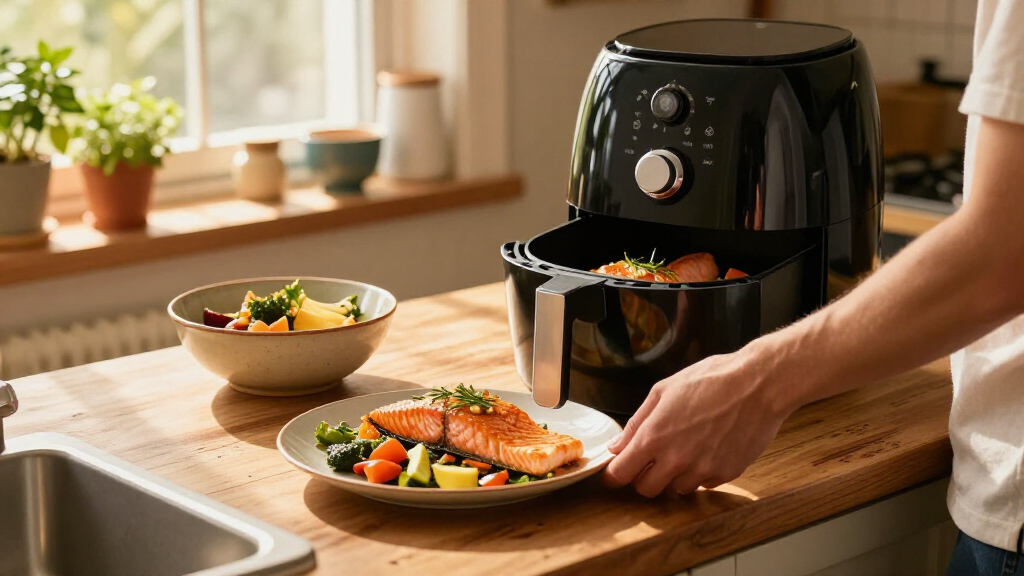
For example, a bowl with air-fried broccoli, brown rice, and salmon starts with vegetables, a filling grain, and protein. A pile of packaged breaded bites cooked in the same machine remains a meal built around a packaged snack. The appliance changes how heat reaches the food; it doesn’t rewrite the ingredient list.
Think of it as a shortcut, not a nutrition plan. If you usually reach for takeout after work, a quick tray of seasoned vegetables and chicken may help you make dinner at home. But if you add a large portion of a salty frozen snack, the air fryer hasn’t removed its salt or changed its portion size.
The air fryer can change the cooking method; you control the meal.
That distinction is especially useful when you see “air-fried” on a package. It tells you something about cooking, not the full nutrition story. Check the ingredients and serving size, then pair the item with fresh or frozen vegetables and another satisfying food when you can.
As an affiliate, we earn on qualifying purchases.
Build a satisfying plate without relying on fries
Air fryers for healthy meals work best when you treat the basket as one part of dinner, not the whole dinner. Pair a colorful vegetable with a protein and a filling side, then season the food so each bite tastes like something you want to eat again. That balance matters because a crisp basket of one food may feel satisfying at first but leave gaps in the meal; vegetables, protein, and a filling side each bring different textures and help make dinner more substantial.
Try a weeknight combination: air-fried salmon, green beans, and microwave-steamed brown rice. Or toss cubed tofu with paprika and garlic, crisp it in the basket, and serve it with broccoli and noodles. You don’t have to cook every part in the air fryer; using the microwave or stovetop for a side saves time and avoids forcing several ingredients with different cooking needs into one basket.
A simple formula helps when you open the fridge at 6 p.m. and see a lonely zucchini, half a block of tofu, and a bag of rice. Cut the zucchini into similar-size pieces, pat the tofu dry, and cook them in separate batches if the basket looks crowded. Separate batches take a little longer, but make it easier for hot air to reach the food and for each ingredient to finish at the right time.
- Vegetables: Try broccoli florets, zucchini, peppers, or green beans.
- Protein: Use tofu, fish, chicken, or other ingredients suited to your recipe.
- Filling sides: Add rice, potatoes, beans, or whole-grain bread.
This approach also makes leftovers useful. Reheat yesterday’s roasted vegetables until hot and crisp, then add a fresh protein or a scoop of beans. The basket can restore appealing texture quickly, while the added foods help turn leftovers into a more complete meal.
As an affiliate, we earn on qualifying purchases.
Use less oil without making dinner dry or bland
You usually don’t need a pool of oil to get good air-fryer browning; a small amount can help food color and keep it from drying out. Oil helps heat transfer across the food’s surface, which can support browning and a less leathery texture. The right amount depends on the ingredient and recipe, so focus on an even, light coating rather than trying to eliminate oil at all costs.
For example, toss chopped potatoes in a bowl with a little oil, salt, and smoked paprika before adding them to the basket. They’ll get a thin sheen instead of greasy patches. Coating in a bowl distributes oil more evenly than pouring it into the basket, where some pieces may get too much and others too little. For vegetables that already contain moisture, you may need only a light spray—or none, depending on the recipe and your preferred texture.
If food comes out limp, oil may not be the problem. Wet surfaces create steam that can delay browning, while crowded pieces block airflow and trap moisture between them. Pat mushrooms dry, leave space between potato wedges, and cook a second small batch rather than forcing everything into one crowded layer. The tradeoff is an extra round of cooking, but it usually gives you more consistent crispness than adding more oil to a crowded basket.
Keep seasoning practical, too. Garlic powder, cumin, pepper, herbs, lemon zest, and chili flakes can bring plenty of flavor without a heavy coating of sauce. If you use a packaged seasoning blend, check its sodium content if that matters for your diet. A squeeze of lemon after cooking can wake up vegetables that looked dull in the basket.
These small adjustments help you keep the best parts—crisp edges, browned surfaces, and quick cooking—without treating “no oil” as a rule. The goal is to use enough oil to suit the food while avoiding unnecessary excess, and to make a meal you enjoy and can repeat, not a dry basket of food you’ll avoid making next week.
digital food thermometer for poultry
As an affiliate, we earn on qualifying purchases.
As an affiliate, we earn on qualifying purchases.
Follow five steps for crisp, evenly cooked food
For crisp air-fryer food, prepare ingredients evenly, keep air moving, and check doneness instead of trusting the timer alone. Cooking times vary by appliance, food thickness, and portion size, so use a recipe as a starting point and make sensible adjustments. The steps work together: even cuts reduce the gap between the first and last pieces to finish, and good airflow helps heat reach the surfaces that need browning.
- Cut pieces to similar sizes. A tray of evenly cut potato wedges will cook more predictably than a mix of thin slivers and thick chunks. If sizes differ widely, the smaller pieces may overcook while thicker ones are still firm.
- Dry food when crisping matters. Pat rinsed vegetables or tofu with a clean towel so surface moisture doesn’t slow browning. This is most useful for ingredients with wet surfaces; it doesn’t mean removing the moisture that makes the inside tender.
- Add only what fits with space around it. A single layer lets hot air reach more surfaces; cook in batches if needed. A full basket may seem like a time-saver, but trapped moisture and uneven airflow can mean soft spots and inconsistent doneness.
- Turn or shake partway through. Follow your recipe and appliance manual, especially for small pieces such as green beans or cubed potatoes. Moving the food exposes different sides to circulating heat, though delicate items may be better turned gently than shaken.
- Check the food before serving. Look for the right texture and use a food thermometer for items such as poultry. Timers estimate; they cannot account for every difference in thickness, starting temperature, or appliance strength.
Imagine you’re making chicken pieces and broccoli on a rushed Tuesday. If you cram both into a packed basket, the vegetables may soften while the chicken cooks unevenly. Cooking the chicken in one batch and the broccoli in another takes a little longer, but both foods get better airflow and more consistent results. You can also start the ingredient that needs more time first, then cook the quicker one while it rests, so the extra batch doesn’t necessarily add the full length of a second cooking cycle to dinner.
Don’t assume every air fryer behaves alike. Basket capacity, heating strength, and cooking times vary by model, so the first batch may need a few minutes of adjustment. Keep notes on what works in your machine, and follow its manual for suitable cookware and operating instructions. This is more reliable than repeatedly adding a large time buffer, which can dry out delicate foods while still failing to solve overcrowding.
As an affiliate, we earn on qualifying purchases.
Compare air frying with deep-frying and oven cooking
Air frying often uses less added oil than deep-frying, while an oven may suit larger portions better. The practical tradeoff is convenience versus capacity: an air fryer can get a small batch browned quickly, but its limited space may mean cooking in rounds. Neither method automatically creates a healthy meal: the result depends on the food, how much oil you add, portion size, and the rest of your diet. Choose the appliance that makes a sensible meal easiest for you.
| Method | What it does well | What to keep in mind |
|---|---|---|
| Air fryer | Quickly browns small portions with little or no added oil. | Small baskets can crowd easily; cooking times vary by model. |
| Deep-frying | Creates a familiar crisp coating and texture. | Food is immersed in oil, so it can take on more added fat. |
| Full-size oven | Handles larger trays and multiple portions. | May need more time to heat and cook a small batch. |
Suppose you’re cooking one serving of broccoli and tofu after work. An air fryer may be faster and easier to clean than heating a full oven. If you’re roasting vegetables for a family gathering, a wide oven tray may fit more food without multiple batches. In other words, the air fryer’s speed advantage matters most when the portion fits comfortably; once you need several crowded rounds, the oven may be more convenient overall.
Air fryers and convection ovens both use circulating hot air, though appliance size and design affect results. There’s no universal winner. Use the air fryer for quick, crisp small batches and the oven when volume matters. If you’re buying a model, a large basket, dual zones, or app controls may suit your routine, but smart features alone don’t make meals healthier. Capacity and ease of cleaning may have a more direct effect on whether you use the appliance regularly and avoid crowding it.
Keep browning moderate and food safely cooked
Golden food and safely cooked food matter more than chasing the darkest, crunchiest finish. High-temperature cooking of starchy foods such as potatoes can form acrylamide, and that can happen with several cooking methods—not only air frying. This is a reason to avoid unnecessarily dark browning, not a reason to avoid potatoes altogether. Aim for a golden color rather than very dark browning, and follow your recipe and appliance guidance.
Picture a tray of potato wedges: pale and floppy isn’t what you want, but deep-brown, nearly burnt edges aren’t the goal either. Check the pieces as they cook and remove them when they’re tender and pleasantly crisp. Since air-fryer models vary, don’t treat one recipe’s timer as a guarantee for your machine. Checking color and texture near the end helps you stop at the point that balances crispness with moderate browning.
Food safety needs its own check. For poultry, use a food thermometer and follow safe internal-temperature guidance; don’t judge doneness by the outside color alone. A browned coating can hide an undercooked center, just as a pale-looking piece may already be safely cooked. The thermometer resolves that uncertainty more reliably than extending the cooking time until the surface looks darker, which can dry out the outside without telling you whether the center has reached a safe temperature.
Grease and crumbs can smoke when they build up. Let the appliance cool, then clean its removable basket and tray as the manufacturer directs. A quick cleanup after cooking helps prevent yesterday’s crumbs from smelling like burnt toast during tonight’s dinner, and can reduce smoke from residue heating again.
For crisp food, aim for golden. For poultry, verify doneness with a thermometer.
If you use parchment or foil, check your appliance manual first. Secure it so it cannot touch the heating element or block airflow, and never preheat with loose paper inside. Loose material can move in the circulating air, while a blocked basket can interfere with the airflow the appliance relies on. These small habits make the machine easier to use without turning a quick dinner into a safety gamble.
Frequently Asked Questions
Are air-fried foods healthier than deep-fried foods?
They can contain less added oil when you cook them with little oil, but the answer depends on the ingredients, portion size, and cooking method. Air-fried vegetables are different from packaged breaded snacks, even if both come out of the same basket.
Do I need to use oil in an air fryer?
No. Some foods cook well with no added oil, while a light coating can improve browning or keep food from drying out. Try a small amount and adjust to the ingredient and recipe.
Can I cook vegetables, fish, tofu, or chicken in an air fryer?
Yes. These are common choices, though timing varies with thickness, portion size, and your appliance. Leave space around the food and use a thermometer for poultry rather than relying on appearance.
Does an air fryer produce acrylamide?
High-temperature cooking of starchy foods, including potatoes, can form acrylamide in air fryers and other cooking methods. Aim for golden rather than very dark results and follow the appliance’s cooking guidance.
Why is my air-fried food not crispy?
Common causes include overcrowding, surface moisture, and blocked airflow. Pat food dry, arrange it in a single layer, and cook in batches when the basket is full.
Can I use parchment paper or foil in an air fryer?
Only if your appliance manufacturer permits it. Secure the material so it cannot touch the heating element or block airflow, and never preheat with loose parchment inside.
Conclusion
Use your air fryer to make balanced food easier, not to give every packaged snack a health halo. Start with vegetables, fish, tofu, chicken, or potatoes; leave room for hot air to move; and serve the crisp results with a filling side.
Remember: the appliance brings the crunch, but your ingredients build the meal. Next time you reach for the basket, give those vegetables a little space—and let dinner come out golden, not crowded.
Halloween Picks
halloween
As an affiliate, we earn on qualifying purchases.