
TL;DR

Get kitchen staples and gadgets delivered free with Prime
- Fast, free delivery on millions of items
- Prime Video, Amazon Music and more included
- Member-only deals all year
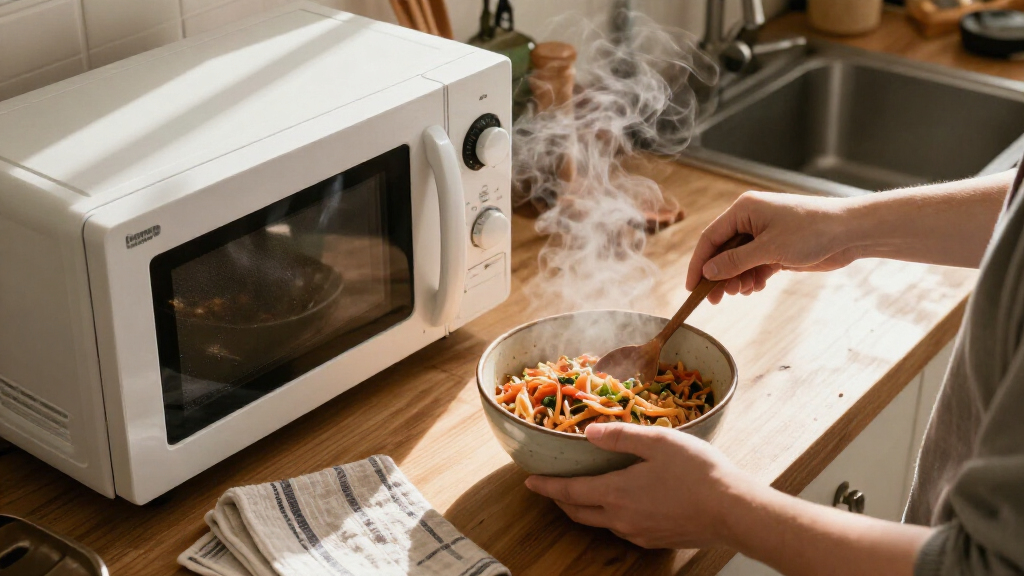
Microwave specialists say the power-level button can help food heat more evenly and avoid drying out or becoming rubbery. Low power suits delicate foods, medium power can help reheat leftovers, and full power is useful for high-moisture foods that need quick heating.
A Good Housekeeping report says microwave users can improve control over heating by adjusting the power-level setting rather than defaulting to full power. Experts cited by the publication say lower settings can help delicate foods heat gradually and leftovers retain moisture, while full power remains useful for foods such as vegetables that need rapid heating.
Microwaves heat food by sending out energy waves that make water molecules vibrate, generating heat. The appliance’s maximum wattage sets its highest output; changing the power level alters how that energy reaches the food. The exact effect depends partly on the microwave’s design.
Traditional microwaves generally cycle on and off at reduced settings, giving heat time to spread between bursts. “Those short pauses give heat time to redistribute more evenly throughout the food,” said Steph Chen, founder and CEO of microwave cookware company Anyday, in the report. Models with inverter technology instead supply a lower level of power steadily, according to Eva Bleyer, a Good Housekeeping Reviews Analyst who tests microwaves.
For many models, users can enter a cooking time, press a button labeled Power or Power Level, and select a percentage or numbered setting. The controls vary, so the report advises checking the manufacturer’s instructions. Some cooking presets, such as popcorn, may not allow users to change power levels.
Better Control Over Everyday Reheating
The setting matters because full power is not suitable for every task. A high setting may heat the outside of a dish quickly while leaving the center cooler, or dry out foods that need gentler heating. Adjusting power gives home cooks another way to manage texture and consistency without changing appliances or cookware.
The advice is practical, not a guarantee of uniform results: microwave wattage, food quantity, container shape and starting temperature can all affect heating. Stirring when possible and checking the food remain useful steps, particularly for foods that heat unevenly.
Products Worth Considering

Le Creuset Enamemed Cast Iron Oval Dutch Oven, 5 qt., White/Crucible

Ninja Mega Kitchen System BL770, 1500W, 72-oz Pitcher and 8-Cup Food Processor, Black

Cuisinart 14-Cup Food Processor, 720-Watt, Stainless Steel (DFP-14BCNY)
As an affiliate, we earn on qualifying purchases.
Which Foods Suit Each Power Level
The report recommends low power for foods prone to burning or separating, including butter, chocolate, custards, and dairy- or sugar-based sauces. It also suggests gentler heat for seafood, chicken, eggs, rice, oats and other grains, which may become dry or rubbery when heated too aggressively. For sauces and soups that can scorch or separate, the source recommends frequent stirring, about every 15 seconds.
Medium power, around 50 percent, can be useful for reheating leftovers, especially items that cannot easily be stirred, such as casseroles, pot pies and burritos. Chen said slower heating can help food warm more gently and retain some moisture. Frozen foods may also benefit from medium power, though heating time will depend on the item and microwave.
Full power is suited to foods with high water content, such as vegetables, soups and sauces, as well as tasks that call for quick heating. The report says to cover dishes to limit splattering and take care when removing them: containers can become very hot. Chen also said high power works for bringing food to temperature quickly, while lower settings can give more control during reheating.
“Most people use their microwave on full power all the time, but full power isn’t always the right setting. It’s similar to cooking on the stovetop—you wouldn’t cook everything on high heat.”
— Steph Chen, founder and CEO of Anyday
Settings Vary by Microwave Model
The report does not provide a single cooking time or power level for each food, and the source material does not include testing data comparing outcomes across models. Microwave controls and heating performance vary, including between traditional and inverter designs, so the examples are general guidance rather than fixed instructions. It is also not clear from the supplied material how much benefit users will see in any specific recipe or appliance.
Users should follow their microwave’s manual and check that food is heated appropriately. The report does not offer detailed food-safety temperature guidance; adjusting the power setting alone does not establish that food has reached a safe temperature.
Check Your Controls Before Cooking
There is no new policy, product launch or follow-up test announced in the report. For readers applying the advice, the next step is to check the appliance manual for how to set power and whether presets restrict adjustment. Start with a suitable lower or medium setting for delicate foods or leftovers, and monitor, stir or check the food as appropriate rather than relying on a preset time for every microwave.
Key Questions
What does a microwave power-level setting change?
It changes how the microwave delivers energy below its maximum output. Traditional models usually cycle on and off at lower settings; inverter models may supply reduced power continuously.
When should I use low microwave power?
The report recommends low power for delicate or easily burned foods such as chocolate, butter, custards and some sauces. It also suggests gentler heating for eggs, seafood, chicken and grains.
Is medium power useful for reheating leftovers?
Yes. The report says around 50 percent power can help reheat foods more gently, particularly dishes that are hard to stir, such as casseroles, pot pies and burritos. Results and timing vary by microwave and portion.
How do I change the power level?
Many microwaves have a Power or Power Level button, sometimes accessed after entering a cooking time. Controls differ, and some presets may block adjustments, so check the manufacturer’s instructions.
When is full power appropriate?
According to the report, full power is useful for quick heating and for high-water-content foods such as vegetables, soups and sauces. Cover dishes to reduce splatters, and handle hot containers carefully.
Source: goodhousekeeping.com